
The FDA guidelines and ISSCR standards recognize G-banding karyotyping as a validated method for assessing the safety and efficacy of stem cell products. As the gold standard, it is the most frequently cited method for detecting chromosomal abnormalities in pluripotent stem cells in the scientific literature.
Its broad acceptance makes it well-suited to GMP standards, and maintenance of a normal karyotype is considered a release criterion for the clinical use of cells (Borgonovo et al., 2014). It is also recognized as a standard safety assay required prior to banking and release (Baghbaderani et al., 2015).
Karyotyping analysis enables the identification of:
- Balanced and unbalanced translocations
- Aneuploidy
- Inversions
- Duplications and deletions
- Abnormalities >5–10 Mb and >10% mosaicism
However, since 2018, publications have increasingly framed G-banding karyotyping as a necessary but insufficient first step, to be complemented by higher-resolution methods, as it cannot detect alterations below 5 Mb.
A key example is the 20q11.21 CNV. This gain is found in approximately 20% of human Pluripotent Stem Cells (hPSCs) lines worldwide and represents the most frequently identified variant (Assou et al., 2020; Avery et al., 2013; Halliwell et al., 2020). It is of critical biological significance, as it is amplified in approximately 20% of human cancers. The 20q11.21 CNV spans roughly 4.6 Mb at its maximum extent (hg38: 31.2–35.9 Mb), though individual cases may involve smaller sub-regional gains within this interval (Krivec et al., 2024).
In the field of hPSCs, it has therefore become best practice to complement G-banding karyotyping with more sensitive techniques to safeguard research integrity.
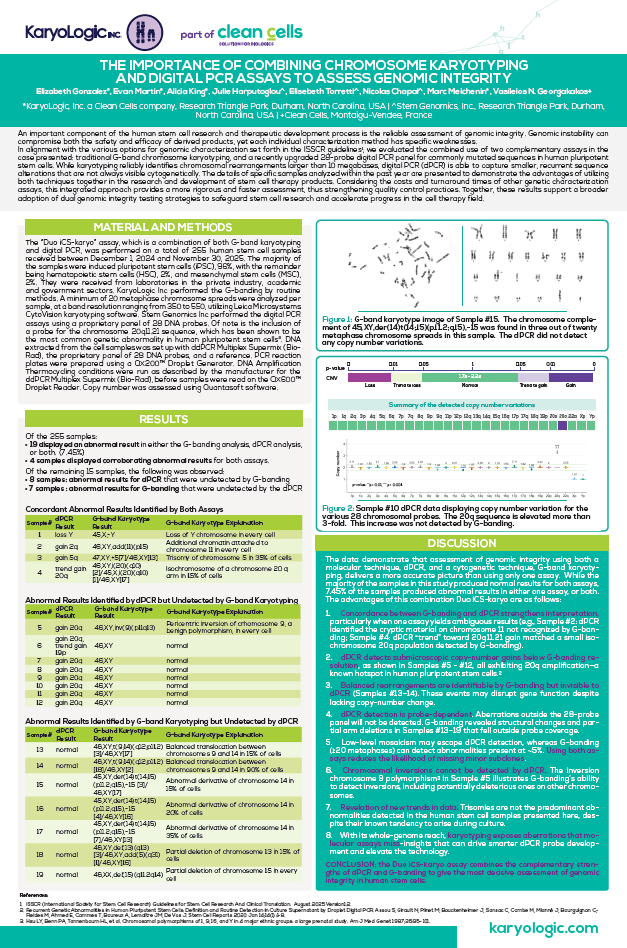
In the following poster, E. Gonzalez demonstrates the advantage of a dual genomic integrity testing strategy combining a digital PCR-based molecular technique with G-banding karyotyping. The analysis was performed on 255 hPSCs received between December 1, 2024 and November 30, 2025. Results demonstrated that this combination delivered a more complete and accurate genomic picture than either assay alone, with competitive costs and turnaround times compared to other genetic characterization assays.
Access the full poster here

Elizabeth GONZALEZ, MS,
Karyologic founder and Senior Cytogeneticist
“Considering the costs and turnaround times of other genetic characterization assays, this integrated approach provides a more rigorous and faster assessment, thus strengthening quality control practices”.
References:
Assou, S., Girault, N., Plinet, M., Bouckenheimer, J., Sansac, C., Combe, M., Mianné, J., Bourguignon, C., Fieldes, M., Ahmed, E., Commes, T., Boureux, A., Lemaître, J. M., & De Vos, J. (2020). Recurrent Genetic Abnormalities in Human Pluripotent Stem Cells: Definition and Routine Detection in Culture Supernatant by Targeted Droplet Digital PCR. Stem Cell Reports, 14(1), 1–8. https://doi.org/10.1016/j.stemcr.2019.12.004
Avery, S., Hirst, A. J., Baker, D., Lim, C. Y., Alagaratnam, S., Skotheim, R. I., Lothe, R. A., Pera, M. F., Colman, A., Robson, P., Andrews, P. W., & Knowles, B. B. (2013). BCL-XL mediates the strong selective advantage of a 20q11.21 amplification commonly found in human embryonic stem cell cultures. Stem Cell Reports, 1(5), 379–386. https://doi.org/10.1016/j.stemcr.2013.10.005
Baghbaderani, B. A., Tian, X., Neo, B. H., Burkall, A., Dimezzo, T., Sierra, G., Zeng, X., Warren, K., Kovarcik, D. P., Fellner, T., & Rao, M. S. (2015). CGMP-manufactured human induced pluripotent stem cells are available for pre-clinical and clinical applications. Stem Cell Reports, 5(4), 647–659. https://doi.org/10.1016/j.stemcr.2015.08.015
Borgonovo, T., Vaz, I. M., Senegaglia, A. C., Rebelatto, C. L. K., & Brofman, P. R. S. (2014). Genetic evaluation of mesenchymal stem cells by G-banded karyotyping in a Cell Technology Center. Revista Brasileira de Hematologia e Hemoterapia, 36(3), 202–207. https://doi.org/10.1016/j.bjhh.2014.03.006
Halliwell, J., Barbaric, I., & Andrews, P. W. (2020). Acquired genetic changes in human pluripotent stem cells: origins and consequences. In Nature Reviews Molecular Cell Biology (Vol. 21, Number 12, pp. 715–728). Nature Research. https://doi.org/10.1038/s41580-020-00292-z
Krivec, N., Ghosh, M. S., & Spits, C. (2024). Gains of 20q11.21 in human pluripotent stem cells: Insights from cancer research. In Stem Cell Reports (Vol. 19, Number 1, pp. 11–27). Cell Press. https://doi.org/10.1016/j.stemcr.2023.11.013